Liminal Space, Grief, and the Long Night of the Soul
Liminal Space in Winter: What the Solstice Can Teach Us About Grief
Grief often asks us to suspend— to slow down, turn inward, and go into neutral.
In therapy, liminal space often describes the psychological in-between that follows loss, trauma, or major life transitions. It is a kind of threshold—a moment marked by a poignant before and after. We find ourselves between who we were or how life once was, and who we are becoming. When we are in liminal space, it asks of us to suspend— to slow down, turn inward, and go into neutral.
Grief, in particular, calls for this suspension. Many of the symptoms we associate with grief are not signs of pathology, but messages that something in us needs to pause and be held. These can include melancholia, emotional strain, brain fog, and disturbances in sleep.
Our society is deeply death- and grief-avoidant, and as a result, these very normal and adaptive responses to loss are often pathologized. Sometimes even well-meaning people encourage us to “keep busy,” when in reality grief asks us to slow down and make space for what we have lost.
“Loss creates a barren present, as if one were sailing on a vast sea of nothingness. Those who suffer loss live suspended between a past for which they long and a future for which they hope.” -Jerry Sittser
Winter Solstice and The Long Night
Winter Solstice marks the longest night of the year, inviting us to turn inwards and be in a state of reflection and remembrance. As we suspend into the darkness of winter, we move through this long night with the quiet knowing that the light will return. And yet, the darkness itself never disappears entirely. It is something we learn not to fear, but to live alongside.
We might think of grief as a psychic winter—an inner season of hibernation, stillness, and reduced movement. In this season, productivity loosens its grip, and survival becomes enough.
What mystics have called the “dark night of the soul” often shows up in therapy as one of the most painful seasons of a person’s life. Existing within a new reality—one we wished desperately were not so—can feel like a long, uncertain journey, akin to a never-ending winter. It is a long night shaped by grief, unknowing, and profound vulnerability.
And yet, as frightening as this darkness can be, there is also much to be found here. The longer night invites us to stay with our grief, to turn toward mystery, and to make space for what may slowly, quietly be unearthed.
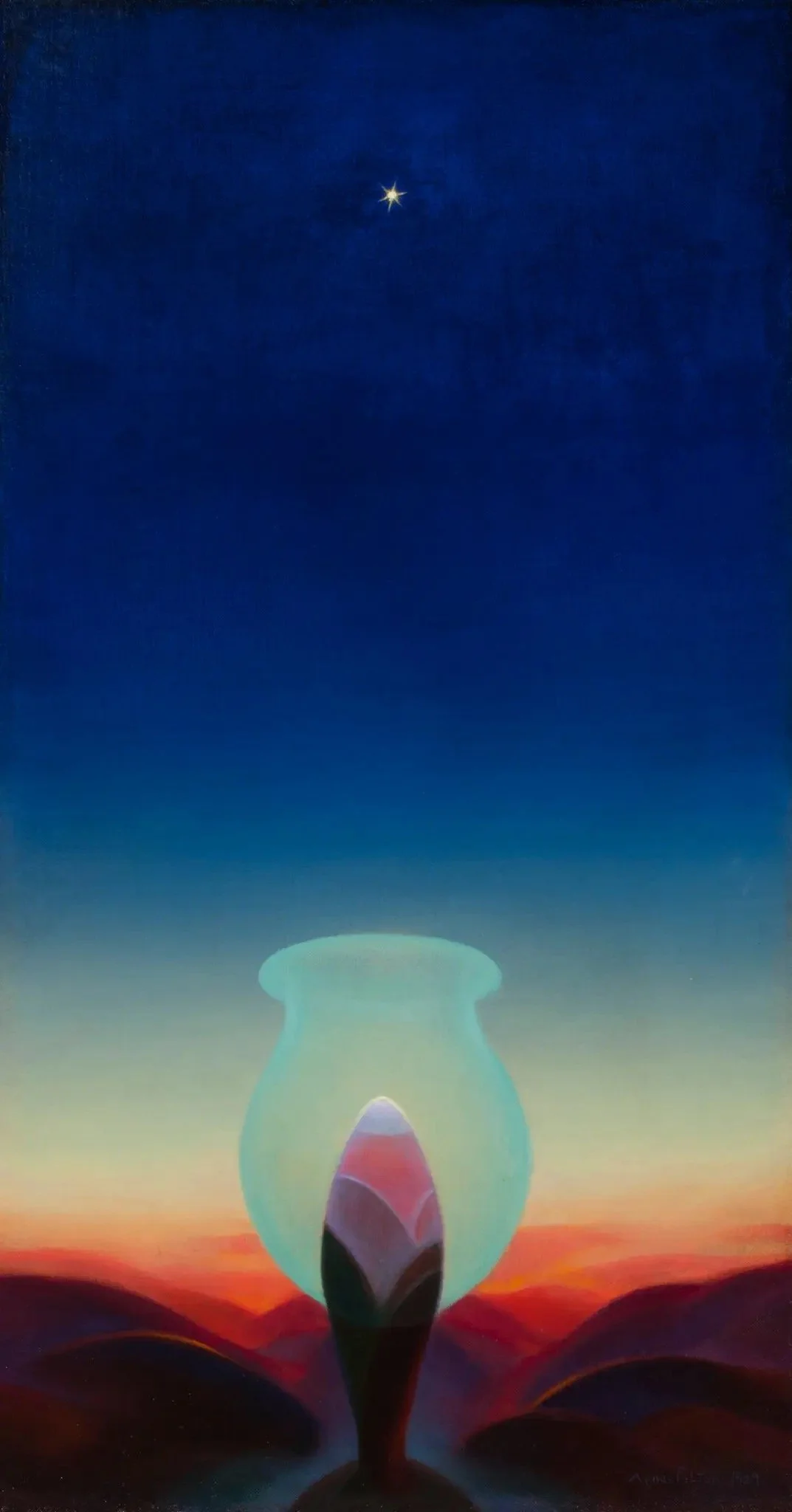
Agnes Pelton’s work reminds us that even in vast darkness, something luminous can be held.
Agnes Pelton, Star Gazer (1929)
Image via Whitney Museum of American Art.
Ways To Be With Grief Through Ritual
Ritual can act as an aid to add rhythms into the long night of grief. Ritual is about marking time, honoring loss, and creating a sense of containment. If this resonates, find a ritual that makes most sense to you and your grief. Here are some ideas:
Candle Ritual
Lighting a candle at the same time each evening can become a way of acknowledging the darkness rather than pushing it away. The flame does not erase the night—it simply keeps you company within it. If you wish, spend some time sitting and staring at the candle -you can light the candle in honor of your beloved or loss. I invite you to extinguish the candle with intention, knowing you can return tomorrow.
Creating a Threshold Moment
Liminal seasons benefit from containment and acknowledgment. Pausing at the start or end of the day to name what you are carrying can help orient you when time feels blurred.
Marking the Body’s experience
Our bodies carry our grief and our physical manifestations of our grief. A ritual might be as simple as making tea for yourself each night or placing a hand on your chest and thanking your body for continuing to carry you through this journey. These small acts honor the body’s wisdom while we are in this space of suspension.
Altar Space
An altar provides a space for grief to be seen and witnessed, this can be just for you or in a place where you wish others to join you in honoring those who have died. In a season of liminality, an altar becomes a quiet act of attention, a way of acknowledging what has been lost without trying to resolve it. Altars can include photos, memento mori, dried flowers, sacred objects, geodes, anything you wish or that serves as a reminder of your beloved.
Winter teaches us that rest, darkness, and stillness are not failures of life, but necessary parts of it. If you are in a psychic winter of your own, may you allow yourself to move slowly, tend gently to what aches, and trust that even now, something is quietly unfolding.
With Care,
—Sarah