
The Myth of the Five Stages of Grief
By Sarah Henderson, LCSW | Grief Therapist in Phoenix, Arizona
If you are grieving, you already know that your grief doesn't follow a script. It doesn't move in a straight line. It doesn't care what month it is or how long it's been. It shows up when it wants to — in the middle of a workday, in the shower, on what had been a “good” day.
And yet, somewhere along the way, most of us absorbed the idea that grief is supposed to have a timeline. Five stages. A beginning, a middle, and an end. A destination called "acceptance" where the pain finally resolves.
That idea has become so deeply woven into our culture that when grief doesn't cooperate — when it lingers, or circles back, or refuses to look the way we were told it should — we begin to wonder if something is wrong with us.
Nothing is wrong with you.
Where the stages came from
In 1969, psychiatrist Elisabeth Kübler-Ross published On Death and Dying, a groundbreaking book based on her work with terminally ill patients. She identified five emotional responses that people facing their own death commonly experienced. Her work was revolutionary — at a time when dying patients were largely ignored by the medical system, she gave voice to their inner worlds.
But here is what gets lost: Kübler-Ross was writing about the experience of dying, not the experience of grieving someone who has died. Over the decades, her model was lifted from its original context and applied to bereaved people — something she herself later expressed regret about. What was meant to be a loose, descriptive framework became a prescriptive roadmap.
And that roadmap has done real harm. It taught us that grief is linear — that it progresses, that it ends. It gave grieving people an invisible second burden on top of their loss: the belief that their grief should look a certain way. And when it doesn't — when anger shows up six months late, when "acceptance" never quite arrives, when you're still crying and everyone around you seems to think you should be further along — the model doesn't question itself. You question yourself.
So many grieving people carry a quiet shame they can barely name. Not just the pain of the loss, but the feeling that they should be over it by now. That they should feel something they don't, or stop feeling something they do. The word "should" follows grief everywhere — I should be functioning, I should be stronger, I shouldn't still be this affected.
But what if the model was never meant for you in the first place?

Grief is not a line. It is a landscape.
If I could offer one reframe, it would be this: grief is not a series of stages you pass through on your way to resolution. It is a relationship — a living, breathing, ever-shifting relationship with your loss, with your love, and with the life you are still being asked to live.
Some days the grief is a whisper. Other days it is a tidal wave. It does not move in a straight line. It circles back. It surprises you. It can be activated by a song, a scent, a Tuesday afternoon in the grocery store. And none of that means you are stuck or regressing — it means you are human, and you loved someone deeply.
In my work, I draw from Existential Analysis, which invites us to meet life as it actually is — not as we think it should be. Grief, viewed through this lens, is not a problem to be solved or a process to be completed. It is an encounter with some of the deepest questions of human existence: What does it mean to love someone who is no longer here? How do I carry this and still say yes to life? Who am I now?
These questions don't resolve in stages. They unfold over a lifetime.
What your grief actually needs
If not stages, then what? What does grief ask of us?
In my experience — both personal and professional — grief asks to be witnessed, not managed. It asks for space, not timelines. It asks for someone to sit with you in the dark without rushing to turn on the lights.
Grief needs permission to be exactly what it is in any given moment — messy, contradictory, sacred, unbearable, and sometimes even beautiful. It needs you to stop measuring yourself against a model that was never meant for you.
And perhaps most importantly, grief needs you to know that there is no finish line. There is no moment where the door closes and you are "done." What there is, slowly and over time, is a widening — a growing capacity to hold both the pain of the loss and the life that is still asking for you. Not one replacing the other. Both, together.
A gentler truth
I wish I could offer you something as neat and reassuring as five stages with an ending. I understand the appeal — when the ground has fallen out from under you, a map feels like safety. But I would rather offer you something true: your grief is yours. It does not need to conform to a model. It does not need to be efficient. It does not need to make sense to anyone else.
If you are grieving and wondering whether you're doing it "right," I want you to hear this: there is no wrong way to grieve. Grief is wild, untamed, and uniquely yours.
Sarah Henderson is a Licensed Clinical Social Worker (LCSW) and grief therapist in Phoenix, Arizona, specializing in grief, traumatic grief, trauma, anxiety/OCD and existential therapy. She offers in-person and telehealth sessions throughout Arizona. If you're looking for grief counseling that honors the full depth of your experience, reach out for a consultation.

Why We See Signs After Loss: Synchronicity, Grief, and Meaning
A dedication to my Jim.
Many people notice signs and synchronicities after a loss — not because they are imagining things, but because grief changes how we experience connection, meaning, and the world itself.
Recently in sessions with my clients, a theme of signs from beloved dead has been a common thread. In grief and loss, we often find ourselves more in touch with mystery — with the part of life that cannot be easily explained. And in those moments, many of us feel quietly held.
These unexplained experiences can involve birds or other animal messengers, seeing our loved one’s favorite car in conspicuous moments, hearing their favorite song at just the right time, or the wind suddenly surrounding us when we are in a space of really missing them.
Carl Jung used the word synchronicity to describe moments when something inside us and something in the world meet in a way that feels too meaningful to be random — especially during times of emotional intensity, like grief.
I have always felt a deep connection to synchronicity. There have been countless moments in my life when I’ve been left awestruck by how events seemed to align in ways that felt both mysterious and deeply personal.
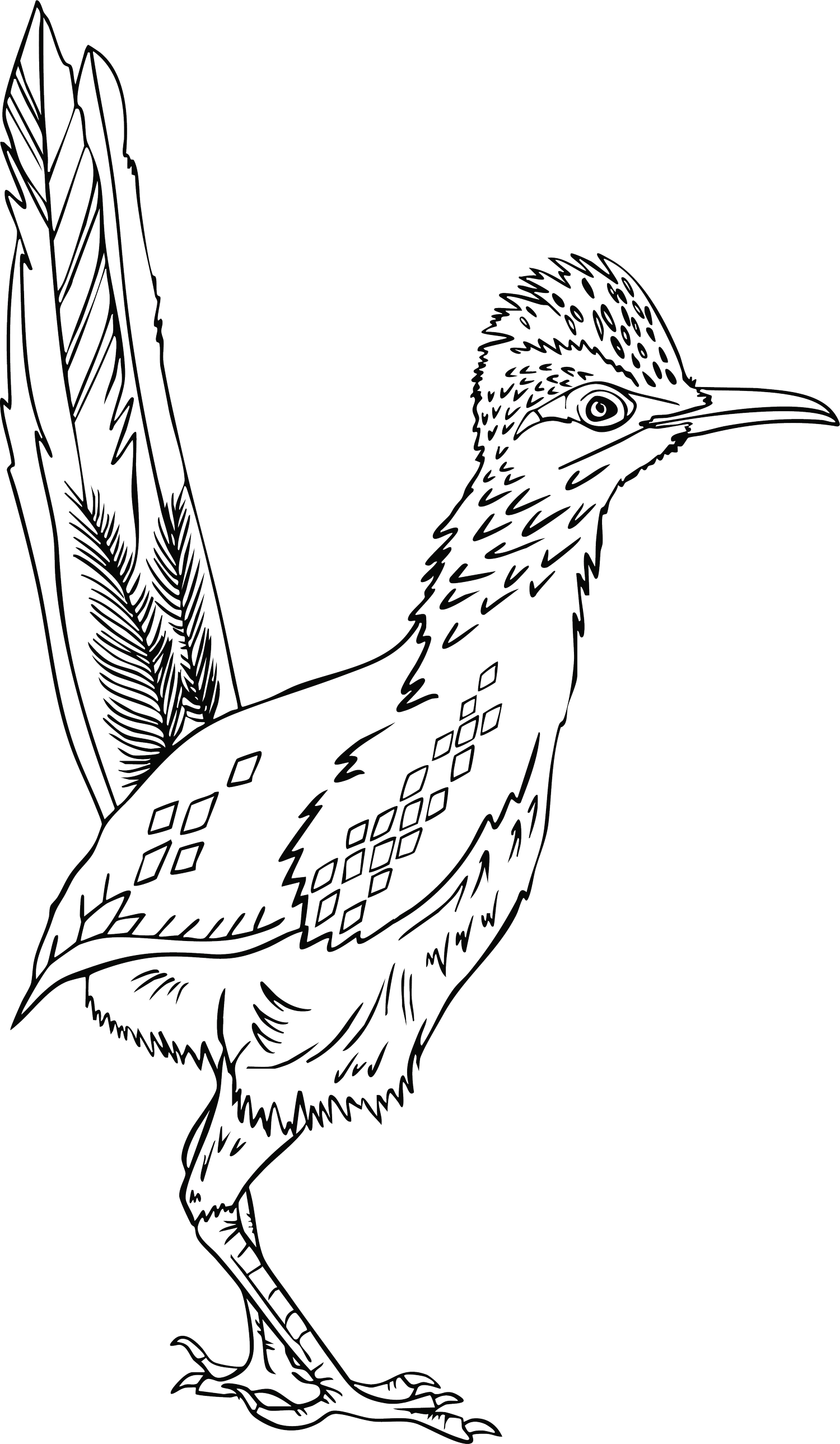
As I write this, my heart feels especially tender. The death anniversary of my beloved step-father, Jim, is approaching. It feels like the right time to share why I chose the roadrunner as my logo.
About a year before he died, Jim called my mom and was exclaiming that there was a “big bird” in our backyard. My mom wasn’t initially sure what he meant, and eventually saw the roadrunner herself and it became a weekly visitor. Jim isn’t originally from the desert and he had never encountered a roadrunner before. A few weeks later the roadrunner stopped visiting.
In the month leading up to his death, just as we were starting to sit with the reality that we were nearing the end—the roadrunner reappeared. I remember the shock and curiosity I felt as I looked out the window and saw our little “big” friend.
In those torturous last days of his life, the roadrunner was there to accompany my family and me as we were saying one of the hardest goodbyes. Since then, there have been countless encounters for me with roadrunners in some of the most pivotal moments of my life— and some of the quiet ones where I was deeply missing my Jim.
Tears come streaming down my face as I make eye contact with these special birds, and each time I see one it takes my breath away. I can’t explain these moments, and I also don’t really ever want to. I surrender to the mystery that is this life, and am deeply grateful for these beautiful encounters.
Each death anniversary feels different. This year marks nine years without him. Year eight honestly felt like one of the heaviest. In memory of Jim, I want to share something I wrote last year:
“8 years without you.
8, how old I was when you and mom got married.
How lucky we were that you had found us.
My grief has felt so heavy this year, I just miss you.
God, how I miss you.
I hold my grief close to me, even with the heaviness I smile and greet it, my dearest friend.
Years and miles and galaxies stand between us now, but I carry you with me everywhere I go.
I hope I find you again one day.”
If you are in mourning and finding yourself noticing signs, coincidences, or moments that feel strangely timed, you are not broken and you are not imagining things. You are in a state of deep love, deep loss, and deep meaning-making. Grief softens the boundary between inner and outer worlds. It makes us porous. It makes us attentive. It transforms us.
Whether you understand these moments as spiritual, psychological, or simply mysterious, what matters most is the comfort they bring. If a song, a bird, a number, or a sudden feeling of presence gives you even a brief sense of being accompanied, let it. You don’t have to explain it. You only have to feel it.
Grief is not the absence of love — it is love in a different form. And sometimes, love still finds ways to speak.
I love you Jim, I hope you are okay.
“I imagine the line
between my life
and your death as
a two-way mirror.
you see me
but i cannot see you.
and every day
i press my palm
up to the glass
and hope your hand
finds it every time.”
—Sara Rian

Liminal Space, Grief, and the Long Night of the Soul
Liminal Space, Grief, and the Long Night of the Soul
Liminal Space in Winter: What the Solstice Can Teach Us About Grief
Grief often asks us to suspend— to slow down, turn inward, and go into neutral.
In therapy, liminal space often describes the psychological in-between that follows loss, trauma, or major life transitions. It is a kind of threshold—a moment marked by a poignant before and after. We find ourselves between who we were or how life once was, and who we are becoming. When we are in liminal space, it asks of us to suspend— to slow down, turn inward, and go into neutral.
Grief, in particular, calls for this suspension. Many of the symptoms we associate with grief are not signs of pathology, but messages that something in us needs to pause and be held. These can include melancholia, emotional strain, brain fog, and disturbances in sleep.
Our society is deeply death- and grief-avoidant, and as a result, these very normal and adaptive responses to loss are often pathologized. Sometimes even well-meaning people encourage us to “keep busy,” when in reality grief asks us to slow down and make space for what we have lost.
“Loss creates a barren present, as if one were sailing on a vast sea of nothingness. Those who suffer loss live suspended between a past for which they long and a future for which they hope.” -Jerry Sittser
Winter Solstice and The Long Night
Winter Solstice marks the longest night of the year, inviting us to turn inwards and be in a state of reflection and remembrance. As we suspend into the darkness of winter, we move through this long night with the quiet knowing that the light will return. And yet, the darkness itself never disappears entirely. It is something we learn not to fear, but to live alongside.
We might think of grief as a psychic winter—an inner season of hibernation, stillness, and reduced movement. In this season, productivity loosens its grip, and survival becomes enough.
What mystics have called the “dark night of the soul” often shows up in therapy as one of the most painful seasons of a person’s life. Existing within a new reality—one we wished desperately were not so—can feel like a long, uncertain journey, akin to a never-ending winter. It is a long night shaped by grief, unknowing, and profound vulnerability.
And yet, as frightening as this darkness can be, there is also much to be found here. The longer night invites us to stay with our grief, to turn toward mystery, and to make space for what may slowly, quietly be unearthed.

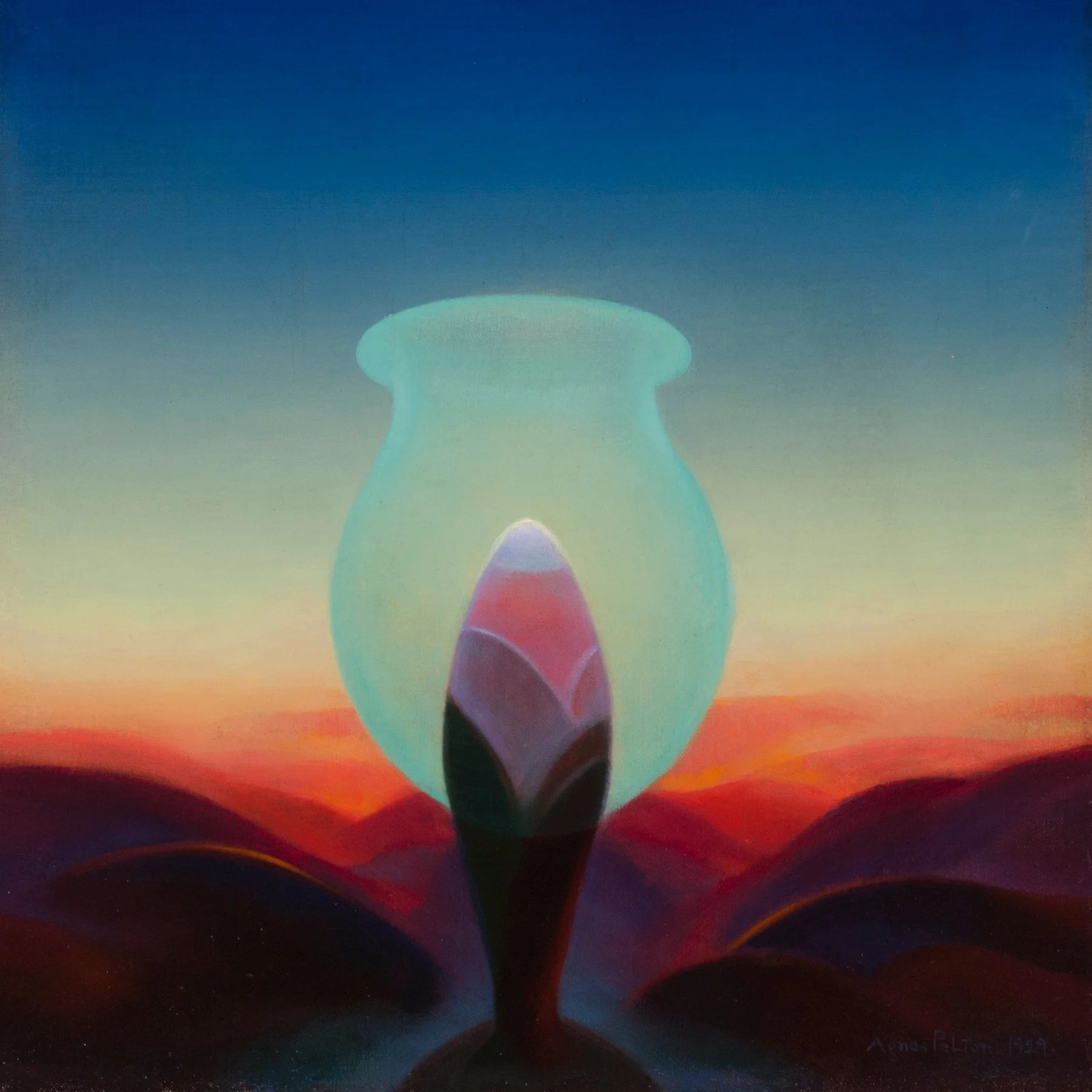
Agnes Pelton’s work reminds us that even in vast darkness, something luminous can be held.
Agnes Pelton, Star Gazer (1929)
Image via Whitney Museum of American Art.
Ways To Be With Grief Through Ritual
Ritual can act as an aid to add rhythms into the long night of grief. Ritual is about marking time, honoring loss, and creating a sense of containment. If this resonates, find a ritual that makes most sense to you and your grief. Here are some ideas:
Candle Ritual
Lighting a candle at the same time each evening can become a way of acknowledging the darkness rather than pushing it away. The flame does not erase the night—it simply keeps you company within it. If you wish, spend some time sitting and staring at the candle -you can light the candle in honor of your beloved or loss. I invite you to extinguish the candle with intention, knowing you can return tomorrow.
Creating a Threshold Moment
Liminal seasons benefit from containment and acknowledgment. Pausing at the start or end of the day to name what you are carrying can help orient you when time feels blurred.
Marking the Body’s experience
Our bodies carry our grief and our physical manifestations of our grief. A ritual might be as simple as making tea for yourself each night or placing a hand on your chest and thanking your body for continuing to carry you through this journey. These small acts honor the body’s wisdom while we are in this space of suspension.
Altar Space
An altar provides a space for grief to be seen and witnessed, this can be just for you or in a place where you wish others to join you in honoring those who have died. In a season of liminality, an altar becomes a quiet act of attention, a way of acknowledging what has been lost without trying to resolve it. Altars can include photos, memento mori, dried flowers, sacred objects, geodes, anything you wish or that serves as a reminder of your beloved.
Winter teaches us that rest, darkness, and stillness are not failures of life, but necessary parts of it. If you are in a psychic winter of your own, may you allow yourself to move slowly, tend gently to what aches, and trust that even now, something is quietly unfolding.
With Care,
—Sarah